
Federal income tax brackets
The IRS has published the federal income tax brackets and standard deduction amounts for tax year 2026. This page collects those figures, with official sources, and explains how they show up in payroll withholding.
This is general information, not tax or legal advice — talk with your tax advisor about your own situation.
2026 standard deduction amounts
For taxable years beginning in 2026, the basic standard deduction amounts under section 63(c)(2) of the Internal Revenue Code are:
| Filing status | Standard deduction |
|---|---|
| Married filing jointly, and surviving spouses | $32,200 |
| Head of household | $24,150 |
| Single (unmarried, other than surviving spouses and heads of household) | $16,100 |
| Married filing separately | $16,100 |
An additional standard deduction of $1,650 applies if the taxpayer is aged or blind. That additional amount is $2,050 if the individual is also unmarried and not a surviving spouse. For someone who may be claimed as a dependent by another taxpayer, the standard deduction cannot exceed the greater of $1,350, or $450 plus the individual’s earned income.
Source: IRS, Revenue Procedure 2025-32, section 4.14.
Ordinary income rates2026 federal income tax brackets
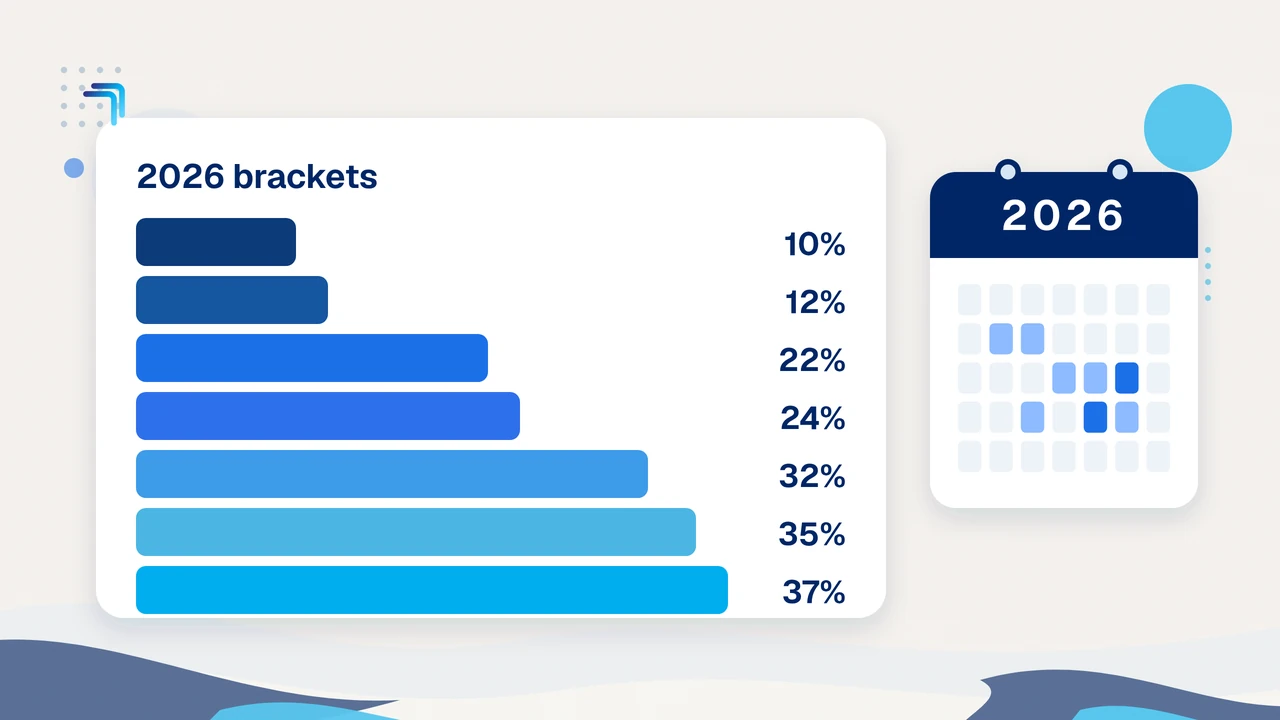
The seven federal ordinary-income rates remain in effect for tax year 2026: 10 percent, 12 percent, 22 percent, 24 percent, 32 percent, 35 percent, and 37 percent. Revenue Procedure 2025-32 adjusts the income ranges for those rates for inflation. These tables show the tax on taxable income for each filing status, as published in section 4.01. “Not over” means the top of that bracket. The tax in a higher bracket is a set amount plus a percentage of the income above the prior cutoff, not a flat rate on every dollar.
Married filing jointly, and surviving spouses
| If taxable income is | The tax is |
|---|---|
| Not over $24,800 | 10% of taxable income |
| Over $24,800 but not over $100,800 | $2,480 plus 12% of the excess over $24,800 |
| Over $100,800 but not over $211,400 | $11,600 plus 22% of the excess over $100,800 |
| Over $211,400 but not over $403,550 | $35,932 plus 24% of the excess over $211,400 |
| Over $403,550 but not over $512,450 | $82,048 plus 32% of the excess over $403,550 |
| Over $512,450 but not over $768,700 | $116,896 plus 35% of the excess over $512,450 |
| Over $768,700 | $206,583.50 plus 37% of the excess over $768,700 |
Head of household
| If taxable income is | The tax is |
|---|---|
| Not over $17,700 | 10% of taxable income |
| Over $17,700 but not over $67,450 | $1,770 plus 12% of the excess over $17,700 |
| Over $67,450 but not over $105,700 | $7,740 plus 22% of the excess over $67,450 |
| Over $105,700 but not over $201,750 | $16,155 plus 24% of the excess over $105,700 |
| Over $201,750 but not over $256,200 | $39,207 plus 32% of the excess over $201,750 |
| Over $256,200 but not over $640,600 | $56,631 plus 35% of the excess over $256,200 |
| Over $640,600 | $191,171 plus 37% of the excess over $640,600 |
Single (unmarried, other than surviving spouses and heads of household)
| If taxable income is | The tax is |
|---|---|
| Not over $12,400 | 10% of taxable income |
| Over $12,400 but not over $50,400 | $1,240 plus 12% of the excess over $12,400 |
| Over $50,400 but not over $105,700 | $5,800 plus 22% of the excess over $50,400 |
| Over $105,700 but not over $201,775 | $17,966 plus 24% of the excess over $105,700 |
| Over $201,775 but not over $256,225 | $41,024 plus 32% of the excess over $201,775 |
| Over $256,225 but not over $640,600 | $58,448 plus 35% of the excess over $256,225 |
| Over $640,600 | $192,979.25 plus 37% of the excess over $640,600 |
Married filing separately
| If taxable income is | The tax is |
|---|---|
| Not over $12,400 | 10% of taxable income |
| Over $12,400 but not over $50,400 | $1,240 plus 12% of the excess over $12,400 |
| Over $50,400 but not over $105,700 | $5,800 plus 22% of the excess over $50,400 |
| Over $105,700 but not over $201,775 | $17,966 plus 24% of the excess over $105,700 |
| Over $201,775 but not over $256,225 | $41,024 plus 32% of the excess over $201,775 |
| Over $256,225 but not over $384,350 | $58,448 plus 35% of the excess over $256,225 |
| Over $384,350 | $103,291.75 plus 37% of the excess over $384,350 |
Estates and trusts use a separate table in the same revenue procedure. This page covers the four filing statuses that show up most often in payroll.
Source: IRS, Revenue Procedure 2025-32, section 4.01.
WithholdingWhat this means for payroll and Form W-4
Employers withhold federal income tax from wages using the employee’s Form W-4 and the IRS withholding methods in Publication 15, Employer’s Tax Guide. The brackets and standard deductions on this page are the income-tax amounts that sit behind those withholding tables. They are not a substitute for the Publication 15 percentage method or wage-bracket tables you use on each payroll.
When a new tax year starts, or when an employee wants to change withholding, they can give you a new Form W-4. For a walk-through of the current form, see how to fill out a W-4. You should not tell an employee what to enter on the form. The IRS Tax Withholding Estimator can help them check the result.
In New York, Form IT-2104 covers state and, if they apply, New York City or Yonkers withholding. A change in federal brackets does not automatically change New York withholding. If an employee is unsure, they should talk with their tax advisor and, if needed, give you an updated W-4 and IT-2104.
This page covers 2026 ordinary-income brackets and standard deductions only. It does not cover New York State income tax rates, capital gains rates, the alternative minimum tax, or credits. We will revise it when the IRS publishes official inflation adjustments for tax year 2027.
How PayNortheast handles federal income tax withholding
PayNortheast calculates, withholds, and files federal, New York, and local payroll taxes on every payroll, and a real person reviews the run before it goes out. Your dedicated account manager can walk through withholding questions that come up when employees update Form W-4, or when a new tax year starts. See what’s included in our full service payroll for employers across New York.
- Federal, New York State, and local payroll taxes calculated, deposited, and filed.
- Year-end W-2 and 1099 filing, with a real person reviewing every payroll.
- A dedicated account manager who knows New York payroll.
Questions employers ask
What are the 2026 federal income tax rates?
The seven ordinary-income rates remain 10, 12, 22, 24, 32, 35, and 37 percent. The income ranges for those rates are in Revenue Procedure 2025-32, and they are listed in the tables on this page.
What is the 2026 standard deduction?
For 2026, the basic standard deduction is $32,200 for married filing jointly and surviving spouses, $24,150 for head of household, and $16,100 for single filers and for married filing separately. Additional amounts apply if the taxpayer is aged or blind.
Do these tables tell me how much to withhold from a paycheck?
No. Use the employee’s Form W-4 and the withholding methods in IRS Publication 15. These tables are the income-tax amounts behind those methods, not a substitute for them.
Official sources for this page
Every figure and rule on this page comes from the sources below, opened November 13, 2026. Re-check them when a new official publication is posted.
- IRS, Revenue Procedure 2025-32 — 2026 tax rate tables (section 4.01) and standard deduction amounts (section 4.14).
- IRS, IRS releases tax inflation adjustments for tax year 2026 — newsroom release of the 2026 inflation adjustments.
- IRS, Publication 15 (2026), Employer’s Tax Guide — federal income tax withholding methods.
- IRS, Tax Withholding Estimator and About Form W-4.
Last updated November 13, 2026. This page does not replace advice from your tax advisor or employment attorney.